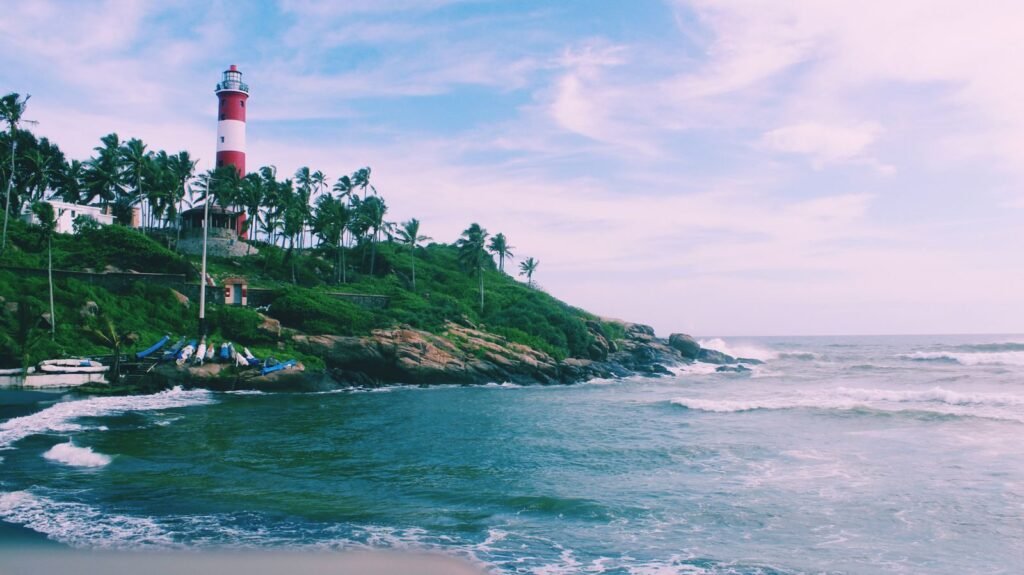
Lighthouse Beach is the most internationally familiar of the three crescent beaches that make up Kovalam on the Malabar coast of Kerala, India. Named for the prominent lighthouse that crowns its rocky promontory, the beach has evolved from a quiet fishing shoreline into one of South India’s earliest modern seaside tourist destinations. This article traces the history of Lighthouse Beach with emphasis on its development as a tourism place: origins, key phases of change, social and economic impacts, and ongoing challenges and initiatives.
Kovalam sits on the southern tip of the Kerala coast, a short drive from Thiruvananthapuram (Trivandrum). The small headland that separates the three bays—commonly known as Hawah (Eve’s) Beach, Samudra Beach and Lighthouse Beach—has long been used by local fishers and coastal traders. Nearby Vizhinjam, just south of Kovalam, is an ancient maritime site with archaeological and historical connections to early trade across the Arabian Sea.
The history of the area cannot be separated from its maritime traditions. The stretch of coast that contains Kovalam and Vizhinjam participated in long-distance trade networks for centuries, connecting local rulers and communities to wider Indian Ocean commerce. These maritime links shaped settlement patterns, livelihoods and cultural exchange long before modern tourism arrived.
For most of its recorded history, Kovalam was a small fishing village dependent on the sea. The local economy was built around fishing, coir, and small-scale trade. From the 18th to the early 20th century the coastline formed part of the Kingdom of Travancore, whose rulers periodically patronized and used seaside spots for recreation and convalescence.
The transformation from fishing hamlet to tourist destination was gradual. In the early 20th century small numbers of domestic and European visitors came to the coast seeking the sea, sun and a tropical climate considered healthful by colonial and local elites. Infrastructure was minimal, but the area’s scenic coves and the presence of a conspicuous lighthouse-like headland began to make it a point of interest.
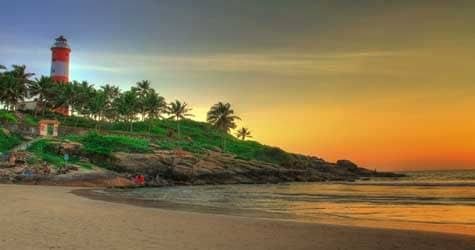
The headland’s navigational light—visible from the rocky promontory—became the defining feature and gave the main beach its modern name. Over time, the lighthouse became symbolic in promotional images and travel literature, attracting visitors who wanted the vantage point and panoramic views the point afforded.
The decisive change in Kovalam’s tourism profile came in the 1960s and 1970s. Like several other coastal pockets in South and Southeast Asia, Kovalam benefited from the rising tide of independent international travelers, backpackers and the so-called hippie circuit. These visitors sought inexpensive seaside locations, local culture, and non-institutional beach life.
From the 1980s onwards tourism in Kovalam, and particularly at Lighthouse Beach, became more structured. Government agencies, private hoteliers, and tour operators invested in better roads, hotels, restaurants and promotional campaigns. Kerala’s tourism policies, which increasingly emphasized “God’s Own Country” branding and responsible tourism concepts, helped integrate Kovalam into state-wide tourism circuits.
Today Lighthouse Beach is a mature, multi-segment tourist destination: it welcomes domestic holidaymakers, international visitors, wellness tourists, and short-stay travelers. The scenic lighthouse headland remains a focal photographic and leisure point. However, as with many long-established coastal resorts, Kovalam faces complex challenges:
Local government, community organizations, hotel associations and state tourism bodies have worked on measures such as beach-cleaning drives, regulated vendor zones, and promoting off-season tourism to reduce peak pressure. The Kerala model of promoting responsible tourism—emphasizing local involvement, environmental stewardship and cultural integrity—has influenced planning and promotional strategies for Kovalam and Lighthouse Beach.
The appeal of Lighthouse Beach goes beyond sand and surf. Visitors come for the layered experiences that grew over decades of tourism development:
Lighthouse Beach has accrued a set of popular associations—romance, easy-going beach life, sunset views and wellness tourism—that continue to shape why people travel there. These associations were built cumulatively across decades and are reinforced in contemporary travel media.
The tourism boom around Lighthouse Beach has demonstrable benefits and costs for local communities:
Beyond hard facts, Lighthouse Beach is a place of layered memories: local fishermen’s stories, early visitors’ travelogues, and the international hippie-era narratives. These stories have meaning for current tourism marketing and local identity—helping Kovalam present itself as at once historic, authentic and contemporary.
Key priorities for Lighthouse Beach going forward include balancing visitor demand with coastal ecosystem health, supporting community-based tourism enterprises, improving infrastructure without destroying the beach’s character, and managing coastal hazards related to climate change.
Lighthouse Beach in Kovalam exemplifies the long arc from maritime livelihood to international tourist destination. Its transformation was gradual: anchored in local fishing communities and maritime trade, catalyzed by mid-20th century travelers and institutional development, and matured into a diversified tourism economy with significant cultural and environmental stakes. The lighthouse itself—an enduring landmark—remains symbolic of Kovalam’s appeal: a place where sea, history and hospitality meet. The future will depend on how well policymakers, communities and business owners manage the twin goals of prosperity and preservation.
Note: This article emphasizes broad historical patterns and the socio-economic context of tourism at Lighthouse Beach. For precise archival dates, architectural data about the lighthouse structure, or technical coastal engineering reports, consult local historical archives, the Kerala Department of Archaeology, or municipal planning documents in Thiruvananthapuram.
What makes us different from other tour package companies
Our travel experts have core and intense knowledge about Kerala sector with over 10 years of experience that will help you choose the best possible itinerary as per your requirements.
Our travel experts are just one call away during your tour to help you with any kind of immediate assistance so that your tour is a more enjoyable and hassle-free tour.
eTourismKerala ensures best rates to all our esteemed guests since we have our own hotels and fleet of vehicles and drivers and there is no third-party involvement. This ensures personalized service and best rates.


















Kindly enter the details below for your Kerala Tour Package